What happens when the promise of affordability compromises safety
Cost often drives patients to seek cosmetic procedures overseas. But what happens when the promise of affordability compromises safety?
Adam*, a 20-year-old from Northern Israel, who is 1.62 meters tall, recently returned from Turkey after undergoing a cosmetic bilateral femur limb-lengthening surgery in April. Traditionally, surgeons perform this complex procedure to correct significant differences in limb length, treat genetic conditions, or repair damage from severe fractures. In recent years, however, it has gained popularity among individuals hoping to add a few centimeters to their height.
Limb lengthening demands a highly specialized team, advanced equipment, and meticulous post-operative care. Unfortunately, Adam’s experience highlights the dangers when these critical elements are missing.
No structured post-operative follow-up, no rehabilitation program
Soon after returning to Israel, Adam developed serious complications and was admitted to Rambam Health Care Campus (Rambam) where he was placed under the care of Professor Mark Eidelman, a world-renowned expert in limb deformity rehabilitation and limb lengthening due congenital anomalies, and director of Rambam’s Pediatric Orthopedics Unit.
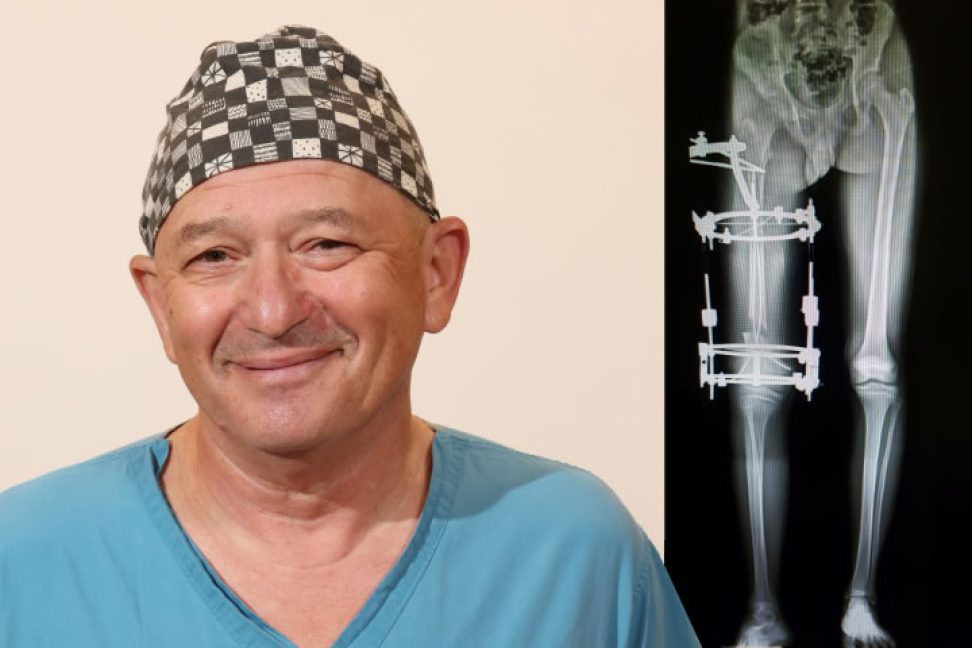
To understand the risks, it helps to know how limb lengthening works. Surgeons first make a controlled break in the bone—often the femur or tibia—and gradually separate the bone segments to allow new bone to form in the gap. Eidelman explains, “An external fixator, essentially a brace with rods that pass through the skin and into the bone, stabilizes the area. We adjust these rods daily by fractions of a millimeter to gradually lengthen the bone.” However, in the last 15 years, a newer method has emerged: internal fixation using a telescopic rod inserted into the bone that lengthens slowly from within, reducing pain and the risk of infection compared to external pins. Eidelman points out that physiotherapy is an important post-operative treatment to aid the limbs in returning to normal function.
When Adam returned to Israel, he was suffering from a chronic infection at each pin insertion site, significant soft-tissue damage, and a failure of the bones to properly fuse. After examining and interviewing Adam, Eidelman and his team had a clear picture of what had gone wrong. The Turkish surgical team had used a combination of an internal telescopic rod and an external fixator in each femur. Based on their findings, Eidelman speculates that some of the fixation devices may even have been second-hand. Furthermore, Adam had undergone no structured post-operative follow-up, no rehabilitation program, and no treatment to prevent infection around the pin sites. “We discovered that the surgical team in Turkey had performed the procedure improperly and failed to conduct any post-operative follow-up—something that would have caught the infection early,” explains Eidelman, who fears the damage to Adam’s limbs may be permanent.
Consequences can be devastating
“He can’t straighten his legs, there’s damage to the soft tissue, and the bones haven’t fused properly,” states Eidelman. “The surgery may have been cheaper in Turkey, but the consequences are devastating. He simply wanted to be a little taller—and now he faces a permanent disability. The infection, combined with the lack of rehabilitation, left him with lasting complications.”
He was recently discharged from Rambam and continues his recovery and rehabilitation within the national health insurance system.