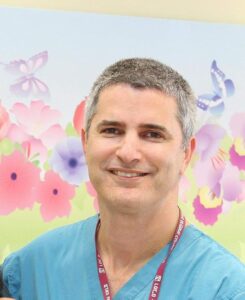
As air‑raid sirens signaled the outbreak of war with Iran, 54‑year‑old Tal collapsed mid‑run on Haifa’s Bat Galim promenade. Suffering from sudden cardiac arrest, his survival depended on the immediate actions of two nearby runners.
Tal and his wife, Froukje, residents of Zichron Yaakov, had gone out for a run in Haifa along the Bat Galim promenade. However, they were running separately, at different paces, when an alert sounded warning residents to enter air-raid shelters, and Tal collapsed from cardiac arrest. Dr. Roni Davidson, a pediatric specialist at Maccabi Healthcare Services, and his running partner, Rafi Cohen, saw Tal lying face down and unresponsive. Although bystanders were present, no one performed CPR. Dr. Davidson began compressions while Cohen called an ambulance and retrieved a defibrillator. After two shocks and continued CPR, Tal started breathing as the ambulance team arrived and took him to Rambam Health Care Campus (Rambam).
Brain injury can begin within three minutes without oxygen
At the hospital, Tal underwent urgent cardiac catheterisation. Dr. Jeries Nashashibi, a physician in the Department of Cardiology at Rambam, says the procedure revealed more than 90% stenosis in Tal’s left coronary artery, the largest of the heart’s three arteries. Such severe narrowing restricts blood flow during exertion, such as running, and can trigger dangerous arrhythmias that lead to cardiac arrest. He further explains that brain injury can begin within three minutes without oxygen, underscoring the importance of immediate CPR and accessible defibrillators in public spaces.
While Tal was being treated, Froukje returned to the promenade searching for him. Showing bystanders his photo, she eventually learned that emergency crews had evacuated a man who had collapsed there earlier. She rushed to Rambam, where she found Tal sedated and ventilated. Tal regained consciousness the next day but did not immediately recognise his family. His condition gradually improved, and he was released several days later in stable condition.
Back home, Tal is continuing to recover. He is expected to undergo a full cardiac evaluation in the coming weeks.
His case underscores the critical importance of rapid CPR, accessible defibrillators, and public readiness to act. Rambam commends the individuals whose immediate response saved a life and reaffirms its commitment to being a leader in cardiac care and catheterisation in Northern Israel.
Based on a Hebrew language article from Ynet News.