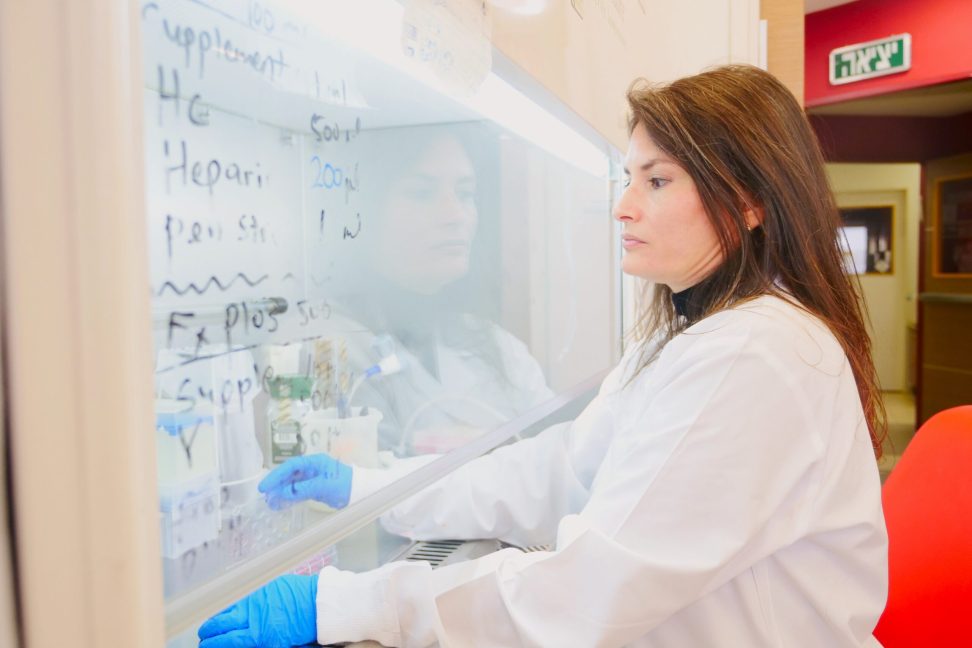
With a global shortage of organs for transplantation and many unmet medical challenges, solutions are taking shape via advanced technologies such as 3D bioprinting. At Rambam Health Care Campus (Rambam), significant breakthroughs are already underway.
Imagine a future with an almost-unlimited, ready‑to‑use supply of organs—potentially without the risk of rejection. This vision is moving closer to reality.
Rambam’s Applied Medical Technology Research Center (MATRiC) is a leading hub for regenerative medicine. MATRiC focuses on developing clinically relevant human tissues—from the cellular level to complex structures—for transplantation, drug testing, and precision (personalised) medicine.

Living tissue is printed layer by layer using the patient’s own cells
At MATRiC, what looks like a standard 3D printer is, in fact, a state-of-the-art bioprinter. Rather than ink, living tissue is printed layer by layer using the patient’s own cells and other biological substances—referred to as bio-ink. The final print-outs are used by clinicians to create disease models and test new drugs before they move on to human trials. This is personalised medicine at its finest, and the potential is enormous.
Dr. Arbel Artzy‑Shnirman, director of MATRiC and a renowned researcher, is particularly focused on the human lung. “First, we must understand tissue anatomy and cell function,” she explains. “Then we translate that knowledge into precise printing instructions to create clinically accurate models.” Her team have already printed functional lung tissue capable of “breathing” with hair-like structures to move and eliminate debris from the lung—mirroring actual lung behaviour.
Aim to assess the likelihood of pre‑cancerous skin lesions
At Rambam’s David and Ruth Lewis Family Charitable Trust Skin Cancer Translational Research Center, Dr. Emily Avitan-Hersh, director of the Department of Dermatology and principal investigator at the Avitan Laboratory at Rambam’s Clinical Research Institute, is collaborating with Dr. Artzy‑Shnirman to integrate MATRiC’s 3D bioprinting technology into melanoma research. By scanning and monitoring skin biopsies, they aim to assess the likelihood of pre‑cancerous skin lesions progressing into malignant melanoma. By introducing suspicious biopsy-derived cells into a 3D bioprinted skin model, the team is able to observe the development of malignancies in a controlled environment and test potential therapies on patient-specific models.
Future possibilities extend far beyond skin and lungs. Bioprinting may one day enable the repair of damaged organs—for example, restoring heart tissue after a heart attack. Even bone replacement could evolve from titanium implants to bioengineered tissue that closely mimics the patient’s natural bone.
Developing new drugs is costly and complex, with toxicity posing a major challenge. A treatment that helps one organ may harm another, such as the liver or heart. Hence, bioprinting offers a potential solution by enabling accurate organ models for testing drug safety and efficacy. While still in early stages, this approach is highly promising.
Bioprinting may significantly reduce the need for animal testing
“There is a real medical need for new approaches and3D bioprinting can open that door,” says Dr. Artzy-Shnirman. “Beyond this, bioprinting may significantly reduce the need for animal testing. It should be minimised wherever possible, and these models can help move us towards that goal.”
As the quality of bio-inks improve, so too does the sophistication of printed tissues. One key challenge is printing blood vessels capable of transporting oxygen and nutrients—an essential step toward viable, larger tissues. When will the breakthrough arrive? Possibly within the next decade or two—perhaps even sooner. With advanced technologies already in use at MATRiC, the path forward is becoming increasingly clear. While today’s bioprinted tissues remain in the early stages, history shows that transformative medical breakthroughs often began exactly this way.